
Heating & Cooling
How heating and cooling choices work together
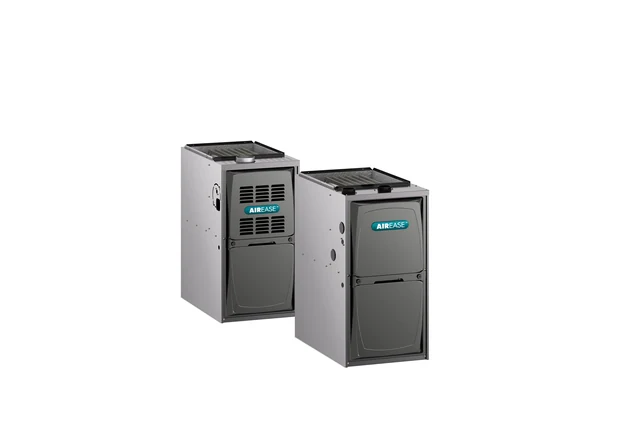
AirEase remains our primary featured brand. Start with what changes in the system’s operation, then compare the equipment and installation together. The AirEase categories above provide the detailed options; the examples below help turn them into useful questions.
Heating output and airflow
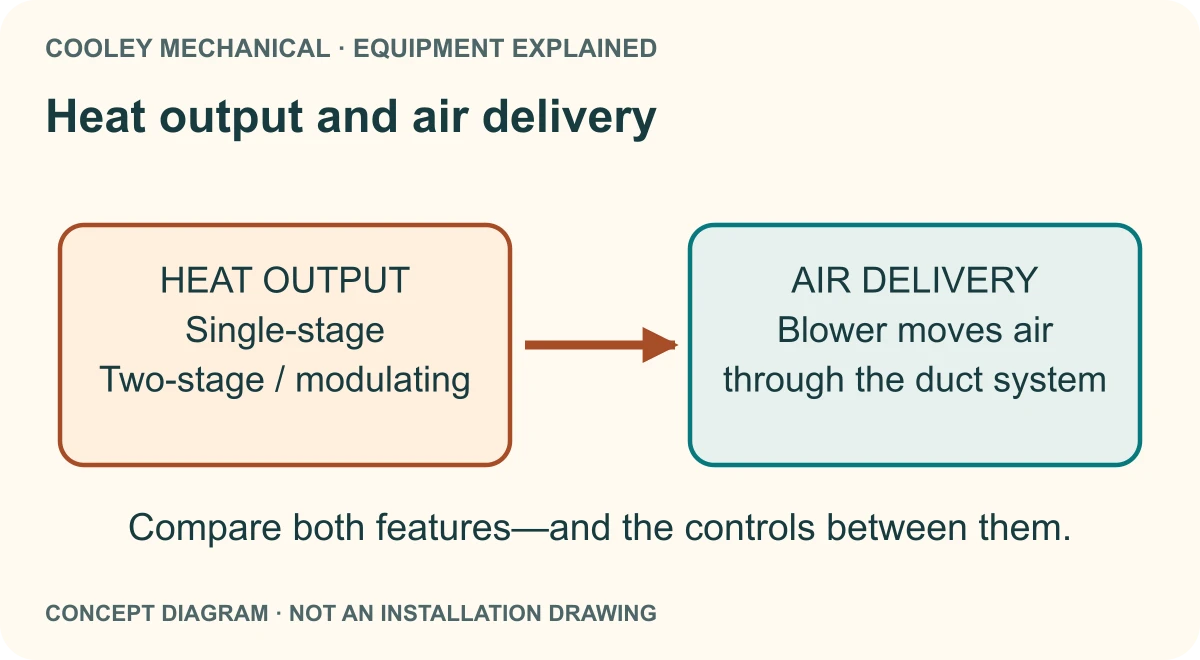
Variable-speed describes the blower. Two-stage or modulating describes heating output; these are separate features.
Knowing the difference helps you compare how a furnace produces heat and how its blower delivers air, rather than treating every feature label as the same upgrade.
Ask how the proposed blower, controls, filter and duct system will work together, and what maintenance access the installation needs.
Cooling output
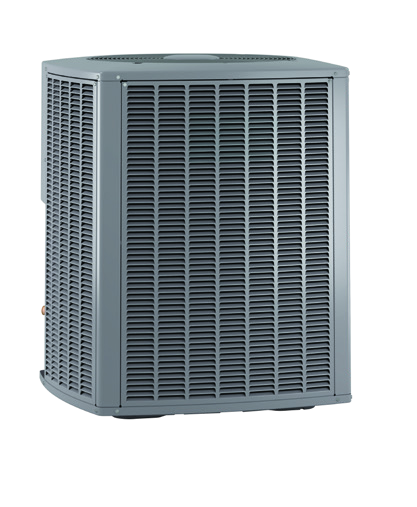
Single-stage cooling runs at one output while the compressor is on, then cycles off. Variable-capacity cooling can adjust its output in small increments as cooling needs change.
This distinction helps you compare how equipment responds to a changing cooling load; it does not establish a savings or comfort result for your home.
Ask how the outdoor unit, indoor equipment and controls are matched, and how airflow will be checked.
Thermostat communication
A conventional 24V thermostat sends heating, cooling and fan requests. A communicating control exchanges system information with compatible equipment to help coordinate operation and report diagnostic information.
Wi-Fi access and equipment communication are different features. Remote access alone does not establish the complete system’s control capability.
Ask which features the proposed combination supports and which controls, sensors or accessories it requires.
Cooley equipment explained · Heating & Cooling
Start with what the system is moving.
Heat output and blower speed are separate choices.
A furnace’s heating stages describe its heat output. The blower moves air through the system. Compare these features separately, then ask how the controls, filter and ducts support the proposed combination.
A variable-speed blower is not, by itself, a claim that the heating output also modulates. The existing AirEase comparisons above help separate those features.
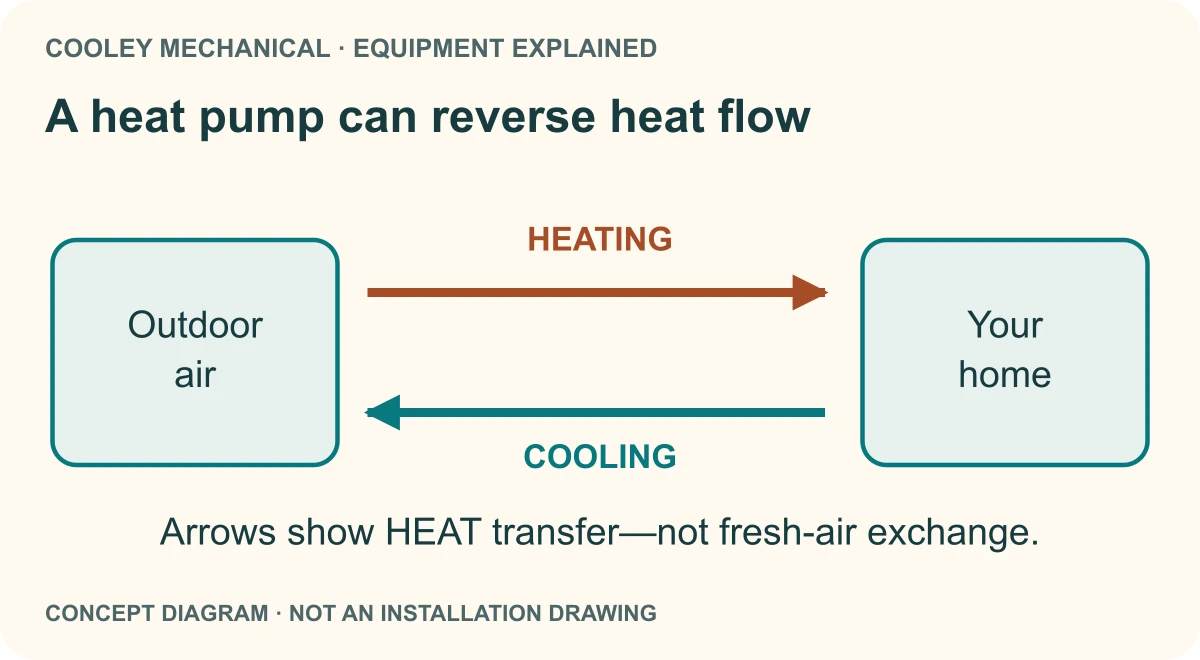
A heat pump changes the direction of heat transfer.
In heating mode, an air-source heat pump moves heat from outdoor air into the home. In cooling mode, it moves heat from inside to outside. That transfer is different from bringing outdoor air into the house for ventilation.
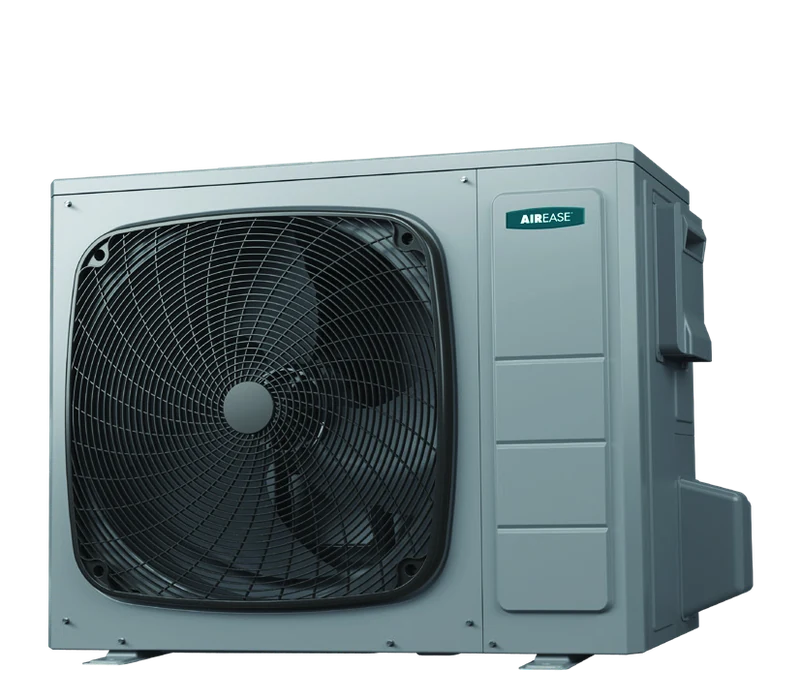
Compare ducted and ductless delivery, the equipment’s cold-weather capabilities, any backup heat and the controls required by the exact system. The existing heat-pump and Samsung sections explain those options.
Operation reference: U.S. Department of Energy: how heat pumps move heat. Only the operating explanation is used here; older incentive and savings claims are not part of this comparison.
SamsungOne room, separate zones or a compatible central system
Cooley Mechanical is a Samsung authorized dealer.
- One room or addition: a single-zone ductless mini split can serve the space without conventional ductwork.
- Several separately controlled areas: Samsung’s FJM multi-zone approach connects multiple indoor units to create independent zones.
- An existing ducted system: a Hylex inverter heat pump may work with compatible indoor equipment or a gas furnace for a dual-fuel arrangement. Samsung’s compatibility conditions apply.
Start with the rooms you want to improve, existing equipment and ducts, cold-weather goals and controls. Cooley will confirm the exact match, capacity, installation scope and availability in the proposal.
Keep the complete indoor and outdoor model numbers. Use their matching manuals, inspect and maintain filters as directed, and ask about filter access and condensate routing.
Supporting manufacturer information: Samsung system types · Exact-equipment manuals · Homeowner care questions.
BoschDucted heat-pump references
Bosch is one of Cooley’s featured residential brands. Its Inverter Ducted Split (IDS) documentation is a starting point for a ducted heat-pump conversation.
Review the outdoor unit, indoor equipment and controls together. If a proposal combines a heat pump with furnace backup, ask how the complete system and controls will be matched for the home.
Manufacturer reference: Bosch IDS technical documentation.
DucanePractical residential comfort options
Cooley offers Ducane as another residential heating and cooling option. Explore furnace, air-conditioning and heat-pump literature, then compare the proposed equipment and installation with what your home needs.
Use the complete model number when reviewing documents. The family name alone does not confirm capacity, a system match or current availability.
Manufacturer reference: Ducane product literature.
BryantDocumentation for your equipment
Bryant remains among the brands Cooley offers. For equipment you already own or a proposed replacement, start with the exact model number and the manufacturer’s document search.
Bring the existing indoor and outdoor model numbers to the conversation. Documents for one component do not establish a complete-system match.
Manufacturer reference: Bryant document search.
Allied CommercialCommercial equipment resources
Allied remains Cooley’s commercial equipment focus. Keep commercial equipment and project requirements separate from residential comparisons.
Manufacturer manuals are a model-specific reference for the project conversation. Installation, diagnosis and service work require the appropriate qualified professional.
Manufacturer reference: Allied Commercial manual index.
Coleman homeowner manuals
Coleman homeowner manuals are available through Johnson Controls Ducted Systems. Match the complete model number and manual revision before use. These general guides cover several brands, including Coleman; they do not establish current product families or the correct manual for every unit.
Model-dependent document references: Gas-furnace homeowner guide · Outdoor AC and heat-pump homeowner guide.
Water Heating
Compare the format before the model
Storage water heaters
A storage water heater supplies hot water from a heated tank. Its first-hour rating estimates how much a fully heated unit can deliver during the first hour.
That delivery measure helps you compare equipment with your busiest household use; tank size alone does not answer the question.
Ask about fuel or electrical connections, venting, service access and the maintenance required by the proposed model.
Tankless water heaters
Tankless delivery is evaluated as flow at the required temperature rise: the difference between incoming water temperature and the hot-water temperature you need.
Compare that delivery with showers and appliances used at the same time. A tankless label does not mean unlimited simultaneous hot water.
Ask how the proposal accounts for incoming-water conditions, gas supply, venting, any condensate and recirculation needs, and model-specific maintenance.
Heat-pump water heaters
A heat-pump water heater uses electricity to move heat from surrounding air into stored water.
Because the room supplies heat, the installation location is part of the equipment decision. It can cool and dry the surrounding space and produces fan/compressor sound.
Review room air and temperature, household demand, electrical supply, drainage, sound and service access against the exact model’s instructions.
Explore the equipment options
Use these examples to connect the operating differences above with your project. Supporting manufacturer documents are linked within each card; Cooley will confirm the exact equipment and installation scope in the proposal.
Cooley equipment explained · Hot water
Storage, flow or heat transfer?
Compare where the heat comes from, how hot water is delivered and what happens during your household’s busiest use.
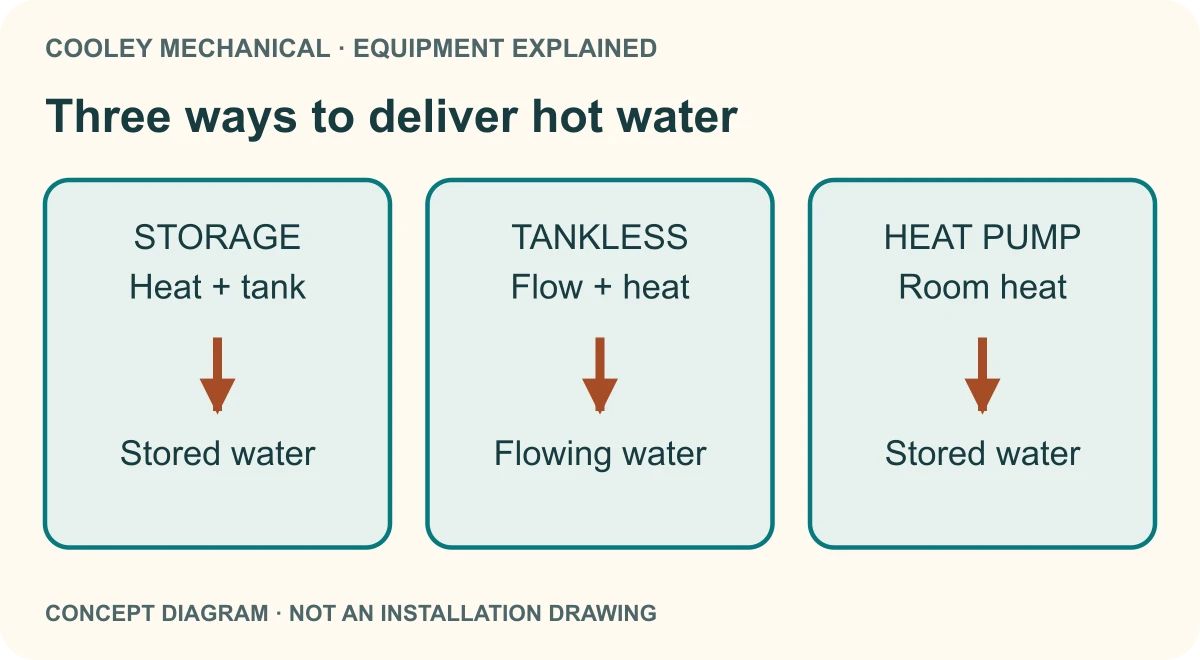
It uses electricity to move heat from surrounding air into the tank. The room’s air and temperature, hot-water demand and the model’s operating modes all belong in the selection conversation.
Use the three comparisons above to discuss simultaneous demand, installation connections, drainage, service access and model-specific care. Then compare the complete proposal with Cooley’s water-heater service options.
Operation reference: ENERGY STAR: how heat-pump water heaters work.
Rheem and RichmondResidential water-heating references
Rheem identifies Richmond as a member of the Rheem Family of Brands. Use the exact manufacturer and complete model shown on the equipment label or proposal when selecting product literature; Rheem and Richmond maintain separate product references.
Discuss the hot-water format and installation requirements first. Confirm the specific product, current availability and written terms with Cooley.
Manufacturer reference: Rheem family of brands · Rheem residential water heating · Richmond product catalog (PDF).
RinnaiTankless product information
Use Rinnai’s tankless product information to prepare questions about your hot-water needs. Describe simultaneous uses and where you want hot water delivered.
Ask which condensing or non-condensing option is being proposed and what that means for its installation, venting, drainage and maintenance. Recirculation should be discussed for the actual plumbing layout.
Manufacturer reference: Rinnai tankless water heaters.
NavienProduct categories for a project discussion
Use Navien’s product overview as background when comparing hot-water equipment. Clarify whether the project concerns domestic hot water alone or also includes space heating.
A combined heating and hot-water project needs its own scope and compatibility review. Ask Cooley to confirm the equipment and scope before treating a combined heating and hot-water system as an option for your home.
Manufacturer reference: Navien product overview.
LGInverter heat-pump water-heater reference
A heat-pump water heater moves heat from surrounding air into stored water using electricity. The room’s air and temperature therefore matter alongside hot-water demand.
LG’s Inverter Heat Pump Water Heater includes a digital display, Wi-Fi compatibility and LG ThinQ monitoring for water temperature and operating mode. Those controls help you see operating information; they do not establish the right size or installation for your home.
Review the exact proposed model, location, room-air conditions, electrical supply, drainage and installation scope with Cooley before selecting equipment. This manufacturer reference is not a confirmation of current model availability.
Manufacturer reference: LG Inverter Heat Pump Water Heater.
Indoor Air Quality
Match the product to the need—and the air system
Cooley works with GeneralAire, AprilAire and Lennox Healthy Climate. Filtration, humidity control and ventilation address different parts of indoor air quality; start with the problem you want to improve.
Particle filtration
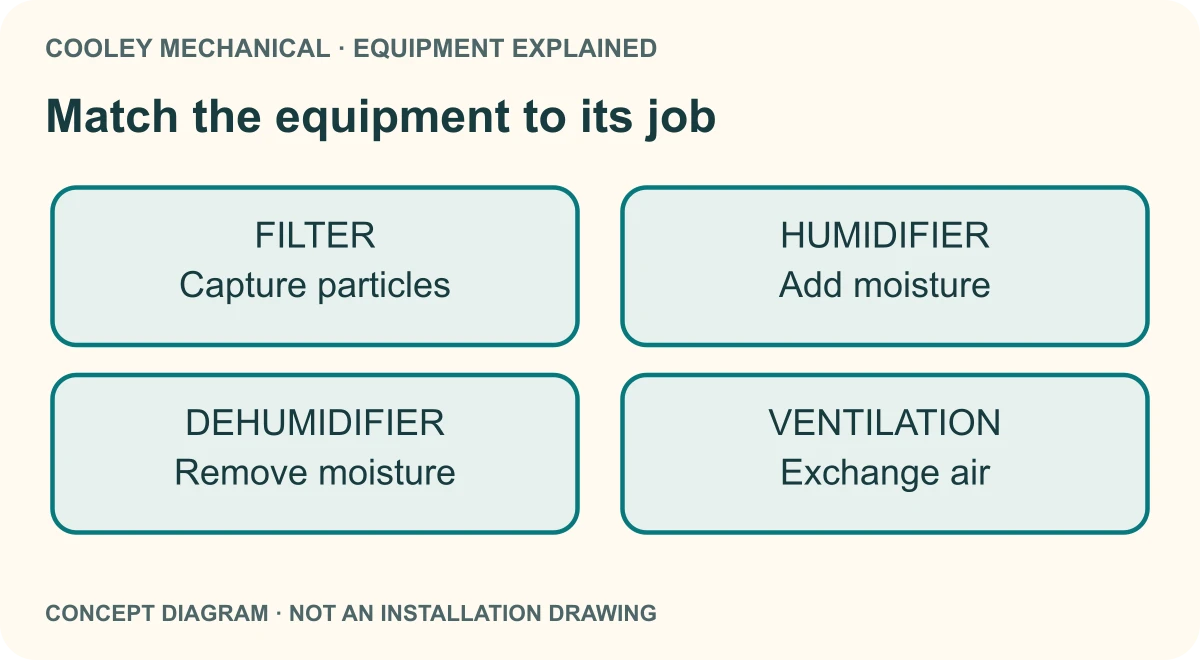
A filter’s job is particle removal from the air moving through it. MERV describes particle-filtering performance; filter fit and the system’s airflow requirements still matter.
Compare filtration and airflow together. Filtration supplements source control and ventilation; it cannot remove every pollutant.
Ask which filter fits the cabinet, how its resistance fits available static pressure, and how to access and replace it.
Adding or removing moisture
A humidifier adds moisture; a dehumidifier removes it. They solve different moisture-control needs and are not interchangeable upgrades.
Start with measured humidity and the moisture source. Existing cooling operation should be considered before adding equipment for persistent humidity.
Discuss water or drainage connections, controls, service access and the manufacturer’s cleaning and maintenance requirements.
Fresh-air ventilation
Ventilation addresses outdoor-air exchange. That is a different function from capturing particles in a filter or changing indoor humidity.
Compare the need for fresh air with the home’s existing ventilation and HVAC system, rather than treating a product label as a complete indoor-air solution.
Ask which airflow paths, controls, duct connections and maintenance requirements apply to the proposed option.
Cooley equipment explained · Humidity
Whole-home humidifiers: follow the air, understand the difference.
Bypass, fan-powered and steam humidifiers all add moisture. The useful comparison is how they make it, how it reaches the rooms, and what your home needs to support that process.
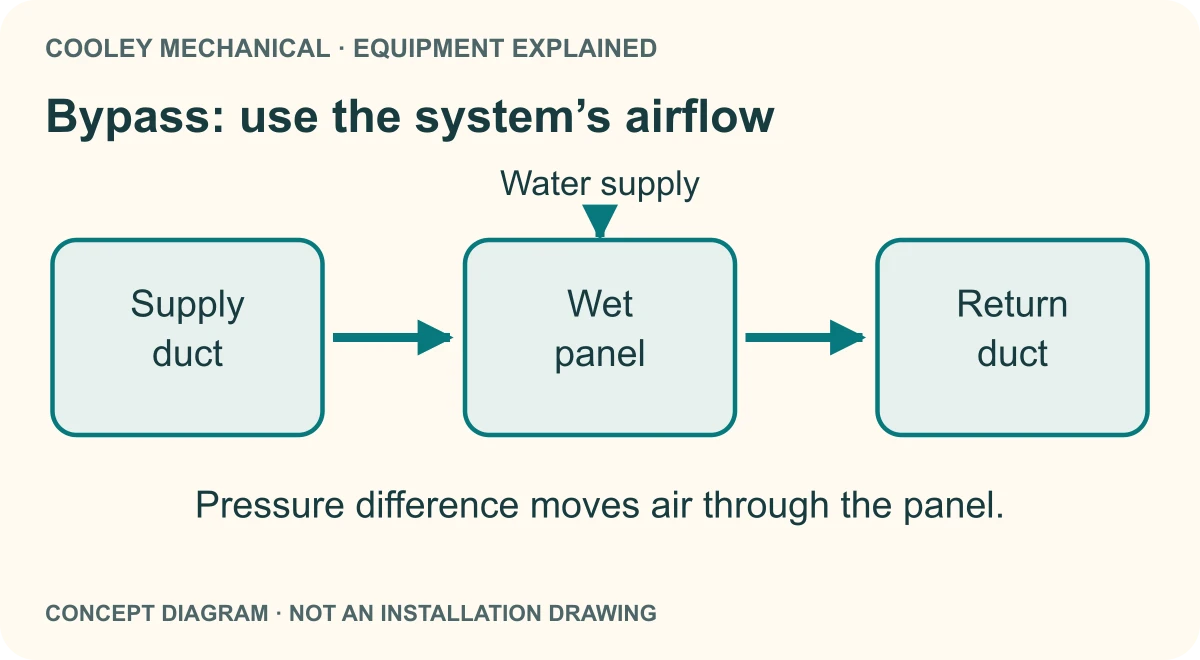
The HVAC blower supplies the airflow.
A bypass humidifier connects the supply and return sides of a ducted system. The pressure difference moves a portion of the air across a wet panel; evaporation adds water vapor before that air returns to the system.
The practical question is whether the duct arrangement has room for the bypass connection, the unit and service access. Its airflow depends on the HVAC blower. Water supply and controls must match the chosen model.
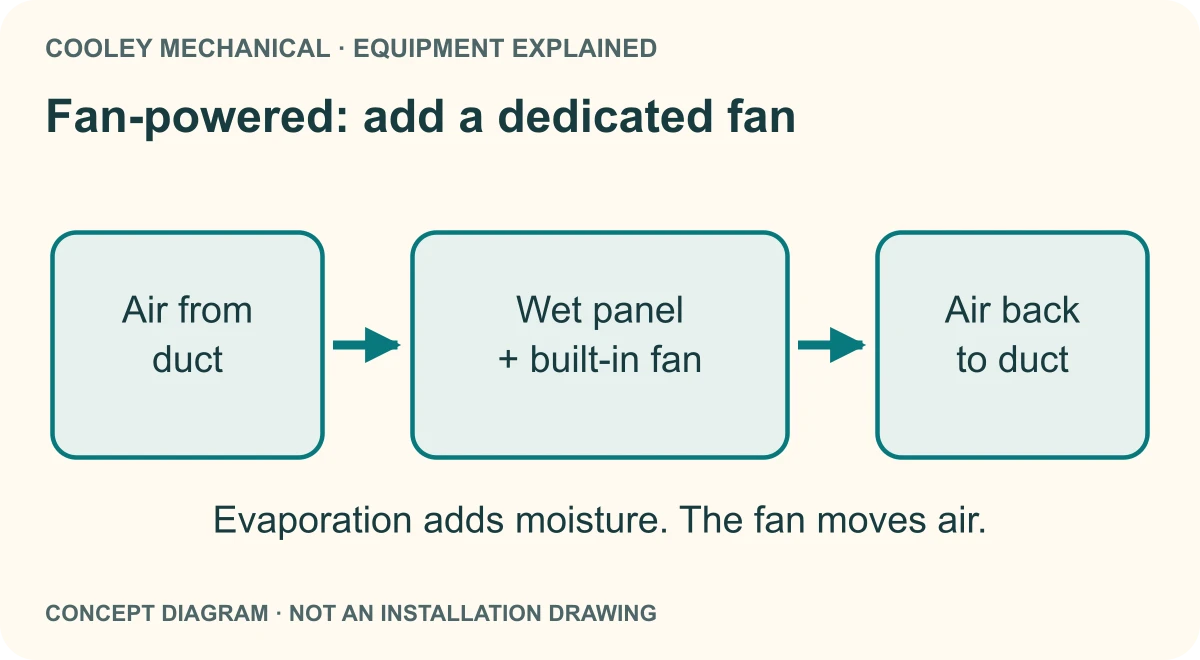
A built-in fan moves air across the wet panel.
A fan-powered evaporative humidifier uses its own fan to move duct air across a moistened panel. It does not need the separate bypass duct used by a bypass model.
That changes the installation layout; it does not remove the need to check the HVAC system, mounting space, electrical connection, water supply and controls. The home’s duct system still distributes the humidified air.
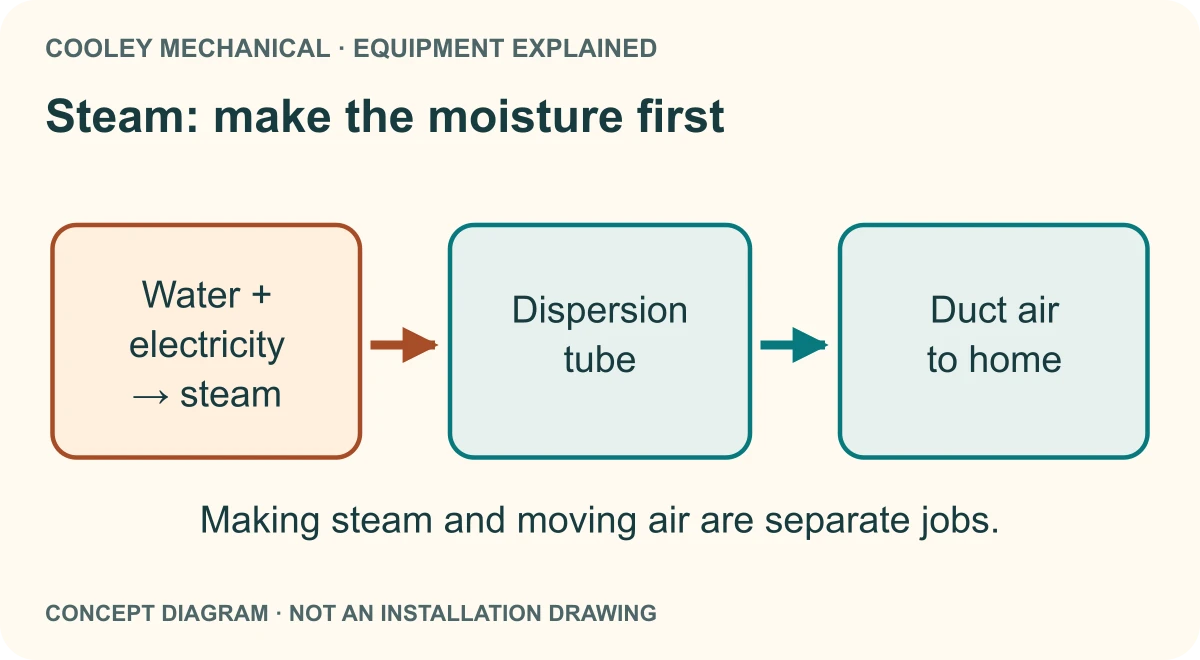
The unit makes steam; moving air carries it.
A steam humidifier heats water electrically and introduces the vapor into the air stream. It can generate moisture without waiting for furnace heat. For a duct-mounted installation, the HVAC blower still has to distribute that moisture.
Ask about the electrical supply, water requirements, drain, dispersion location and available airflow. Canister-style equipment also needs access for its scheduled service.
Compare the work each type needs.
These are operating differences, not a ranking from good to best. The right choice starts with the home and the installation.
Bypass
- Moisture process
- Evaporation at a wet panel.
- Air movement
- HVAC blower and supply-to-return pressure difference.
- Planning question
- Where can the bypass connection and service space fit?
Fan-powered
- Moisture process
- Evaporation at a wet panel.
- Air movement
- A dedicated humidifier fan; no separate bypass duct.
- Planning question
- Will the mounting, power and controls suit the system?
Steam
- Moisture process
- Water is heated to make steam.
- Air movement
- Steam enters the air stream; the HVAC blower distributes it.
- Planning question
- What power, water, drain and dispersion provisions are required?
Bring the home into the decision.
- Start with measurements. What humidity readings do you see, in which rooms, and under what outdoor conditions?
- Describe the heating system. Is it a furnace, a heat pump or another arrangement? Include the indoor unit and control model numbers.
- Compare the installation. Ask where the unit will mount, how water and drainage will be handled, and what electrical and control work is included.
- Make upkeep visible. Ask which replacement panel or canister is required, what access it needs and which tasks belong in professional service.
Condensation can form when moist indoor air meets a cold surface. Record where it appears and the conditions when it happens; review humidity settings and the moisture source instead of assuming the house needs more humidification.
A Michigan home’s operating conditions change through the winter. Ask Cooley to explain how the selected control responds and when its setting needs attention. A floor-area label alone cannot answer every sizing or installation question.
Plan maintenance when you choose the equipment.
For evaporative models, identify the correct water panel and follow the model’s replacement and cleaning instructions. For canister-style steam equipment, identify the correct canister and its service requirements. Water conditions and the exact model matter; there is no single replacement schedule for every humidifier.
Keep the model number, owner’s manual and service record together. Ask which seasonal control or bypass-damper steps apply to your installation, and arrange service for leaks, recurring alerts or uncertain operation.
Questions homeowners ask
Does a fan-powered humidifier replace the furnace blower?
No. Its fan moves air through the humidifier. The HVAC system still handles distribution through the home.
Does steam mean the furnace must be heating?
No. Steam generation can operate independently of furnace heat. A duct-mounted installation still needs the correct airflow and control arrangement to distribute it.
Is a humidifier also a dehumidifier or air filter?
No. Adding moisture, removing moisture and capturing particles are different jobs. Explore whole-home dehumidification or review filters, airflow and ductwork when those are the concerns.
Compare the equipment and the installation together.
Tell Cooley what you are noticing, what equipment you have and what you want to improve. We can discuss the measurements and system details needed for a useful recommendation.
Discuss humidity with CooleyTechnical reading behind this guide
- Bryant: humidifier type comparison · fan and evaporative-pad example · steam-generation and canister example
- AprilAire: airflow, controls and humidifier questions
- AprilAire: model-specific maintenance guidance
- EPA: moisture and condensation
Illustrations are original Cooley concept diagrams. Exact connections, clearances and operating instructions come from the selected equipment’s manual.
GeneralAireHumidity control and media filtration
Use GeneralAire’s product and catalog references to explore humidification, media filtration and dehumidification. Bypass, powered and steam humidification require different installation and maintenance considerations.
For a GeneralAire MAC-series media cabinet, confirm the cabinet identification, compatible filter and room to remove it. Ask how the filter choice fits the system’s airflow and available static pressure.
Manufacturer reference: GeneralAire products · GeneralAire product catalog.
AprilAireHumidity, filtration and fresh-air references
AprilAire is one of the indoor-air-quality brands Cooley works with. AprilAire describes Model 600 as a large bypass evaporative humidifier with automatic digital control; Model 600M uses manual control.
Compare humidification, filtration, dehumidification and fresh-air ventilation from the measured need, system and duct fit, airflow, drainage, controls and maintenance access. A manufacturer’s catalog listing does not select the model for your home or confirm Cooley’s current model availability.
Manufacturer reference: AprilAire humidifier catalog · Model 600 information · Humidifier control FAQ · Whole-house filtration · Whole-house dehumidification · Fresh-air ventilation.
Lennox Healthy ClimateMedia cabinets and replacement filters
Healthy Climate is a Lennox product line. Cooley’s focus here is basic media filter cabinets, racks and compatible replacement filters.
Match the filter to the exact cabinet. Review MERV, fit, replacement access and airflow together; a higher filter rating by itself does not establish suitability for the system.
Manufacturer reference: Lennox Healthy Climate overview · Lennox filter specifications (PDF).
Persistent humidity also deserves a look at the moisture source and existing cooling operation. Read Cooley’s whole-home dehumidifier guide.