Cooley Mechanical · Furnace field notes
A 5,000 ppm analyzer display during furnace-exhaust testing: why context matters
A Saint Clair Shores furnace visit raises an important question: what could be behind an exhaust-test warning?
Finding reported October 20, 2026 · Saint Clair Shores, Michigan
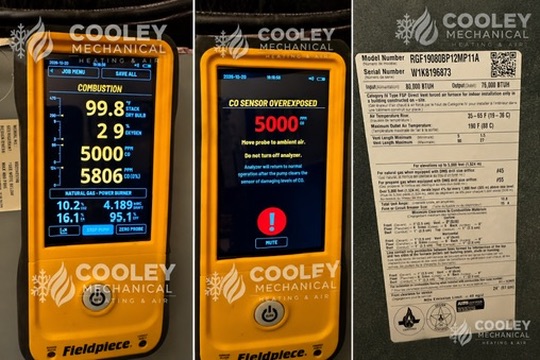
The furnace had been installed in 2018. During our furnace-exhaust testing in Saint Clair Shores on October 20, 2026, the analyzer displayed 5,000 ppm, alongside the warning “CO SENSOR OVEREXPOSED.”
The number was displayed during an exhaust test. It was not a measurement of the air inside the home, and it does not by itself establish anyone’s exposure or a failed heat exchanger.
Was the heat exchanger plugged, cracked or corroded—or was the problem elsewhere? Those are reasonable questions. Understanding the possibilities starts with how the furnace burns fuel and what a qualified inspection actually finds.
Where the sample came from matters
Carbon monoxide can be present in the fumes from fuel-burning equipment, including furnaces. It is colorless and odorless, and a buildup indoors can poison people and animals. The CDC explains CO sources, health risks and prevention.
Here, we were testing furnace exhaust. An exhaust result cannot be presented as an indoor-air reading or used on its own to declare the air in a home safe or unsafe. Those are different questions.
For a homeowner reviewing a service report, the useful question is: “Where was this measurement taken?” The answer should accompany the number, so an equipment test is not confused with a measurement of the air people were breathing.
What might a professional investigate after an exhaust-CO warning?
Carbon monoxide forms when fuel does not burn completely. The air-to-fuel balance and flame conditions matter. CPSC staff’s combustion research explains these mechanisms.
Restricted combustion air or exhaust
The burner needs combustion air, and exhaust needs a clear route out. A blocked combustion-air intake or vent can disrupt that process. A partially plugged heat exchanger is another possible restriction in the combustion-gas path. A restriction and a crack in the metal are different problems.
Burner or fuel setup
Too much fuel, excessive gas pressure or burner misalignment can contribute to incomplete combustion. These are professional investigation areas, not adjustments homeowners should make. CPSC staff’s furnace hazard analysis distinguishes combustion problems from paths through which exhaust can escape.
Cracks, corrosion and rust
The heat exchanger transfers heat while separating combustion gases from household air. A confirmed crack can compromise that barrier, and corrosion can weaken the metal. Trane’s heat-exchanger explanation discusses these concerns. A crack alone does not establish the cause of a high exhaust-CO result. Rust alone does not prove a crack, a leak or any particular CO level.
For this October 20 account, the cause remains unconfirmed. The next step should follow documented findings, not an assumption that the furnace needs replacement.
The warning needs its instrument context
The words “CO SENSOR OVEREXPOSED” belong in the service explanation alongside the displayed value. Any interpretation of that warning needs to follow the instructions for the specific analyzer. The warning should not be turned into a guessed measurement limit or a claim that the actual concentration exceeded the displayed number.
A display and warning are also not a complete furnace diagnosis. They do not, by themselves, confirm a heat-exchanger failure or identify a repair. Those conclusions need their own documented findings from a qualified professional.
What to ask for in a clear service explanation
A homeowner should be able to understand the finding and the next step without having to interpret an analyzer screen alone. Useful questions include:
- The observation: What did the technician see, and when?
- The measurement: Where was the sample taken, what did the instrument display, and were there warnings or limitations?
- The diagnosis: Which findings support the proposed cause, and what remains uncertain?
- The recommendation: What action is recommended, and what evidence supports it?
- The outcome: If work was completed, what was done and what follow-up results were recorded?
These are questions for the service professional, not instructions to open, adjust or test a furnace yourself. An installation date such as 2018 is useful background; it is not a diagnosis, a reason by itself to replace the furnace, or proof of warranty coverage.
Keep the finding separate from the outcome
This article describes the October 20 finding, not a completed repair. Our aim is to help homeowners understand the questions behind a furnace test and ask for a clear explanation of any recommended work.
For routine prevention, the CDC recommends yearly service of heating systems and other fuel-burning appliances by a qualified technician. Maintain CO alarms according to their manufacturer’s instructions. Alarms and professional appliance care serve different purposes; one does not replace the other. See the CDC’s CO prevention guidance and CPSC’s alarm guidance.
For more homeowner guidance, read furnace warning signs and what to do. Our Washington Township furnace repair page explains our repair-service approach. For a non-emergency question about your furnace, contact Cooley Mechanical to ask about service availability.