
Cooley Mechanical · Home care
Michigan Fall Home Maintenance Checklist
Disconnect the hose. Bring out clean, dry bedding. Remember the bathroom nobody uses. A useful fall routine reaches beyond the furnace—and starts with the things that are easy to overlook.
Before Michigan settles into freezing nights and more time indoors, take a walk around the house with a short list. Handle the straightforward upkeep you can do safely, write down what seems different, and arrange help for the jobs that need it. You do not have to turn one Saturday into a complete home inspection.
01 · Outside
Disconnect garden hoses before they freeze in place
Turn the outdoor faucet off, disconnect the hose and drain and store the hose as its instructions direct. Do this while the connection is accessible and conditions are safe. Do not force a stuck fitting.
“Frost-proof” still comes with conditions. On a standard frost-proof faucet, an attached hose can keep water from draining out of the faucet; that trapped water can freeze. Woodford’s explanation of the standard design shows why drainage and installation matter.
Identify your particular faucet and follow its winter instructions. Different designs have different protections and procedures; disconnecting a hose is not a promise that every faucet is ready for winter. If the faucet leaks, the connection will not release, or you cannot identify the required procedure, have a plumber assess it before freezing weather. An insulating cover is not a substitute for correcting a leak or following the faucet’s instructions.
Look at gutters and downspouts from the ground
Look for leaves at accessible outlets, disconnected downspouts, overflowing sections and water collecting near the foundation. After an ordinary rain, note where the water actually went. Keep existing ground-level discharge paths clear where you can do so safely.
FEMA’s National Flood Insurance Program checklist explains that clearing leaves and debris from gutters and downspouts helps prevent overflow. Avoid routing water toward a neighbor or creating a wet, freezing walkway. Larger drainage changes need advice appropriate to the property.
Leave roof access, ladder work, overhead hazards and hard-to-reach gutter cleaning to a qualified professional. A ground-level observation and a clear photo are useful without climbing up to investigate.
02 · Water paths
Give the sump pump a check before you need it
Find the instructions for the installed pump, alarm and any backup system. From a dry, safe position, check the normal status indicators and look for a blocked or disconnected outdoor discharge. A light on the controller does not by itself prove that the pump moves water.
If the manufacturer’s routine test permits adding water and the basin is safely accessible, follow that procedure and observe the automatic start, water removal and stop. Stop adding water if the pump does not respond or the level keeps rising. NDSU Extension explains the water-test principle; the procedure for your pump and backup still controls.
Do not reach into an energized pit, bypass a float switch, open electrical components or disturb a sealed cover for this checklist. If testing requires those steps—or you are unfamiliar with the system—ask a plumber to check it. The alarm and backup need their own prescribed tests; one successful primary-pump cycle does not verify everything.
Standing water changes the situation. Do not enter water to reach a pump, plug or electrical panel, and do not handle wet electrical equipment. CDC’s electrical-safety guidance calls for an electrician when reaching the shutoff would require entering standing water.
Remember the guest bathroom, utility sink and floor drain
A plumbing trap retains water that separates the room from the sewer piping. In a little-used sink, shower or floor drain, that water can evaporate. The South Davis Sewer District’s trap guide explains this easily missed source of odors.
Use the little-used sink and shower, and flush a little-used toilet so its bowl refills normally. For a known, connected sanitary floor drain that flows freely, add plain water slowly to replenish its trap; stop if water backs up. Do not pour water into an unidentified opening, electrical enclosure or sump as a substitute for knowing what it is.
Restoring a water seal is different from installing a device. An automatic trap primer is one way to help maintain a floor-drain water seal. This does not mean every drain needs a mechanical primer. Have a plumber identify the installed arrangement and whether it needs repair or an appropriate form of trap-seal protection.
If an odor persists or returns, the trap repeatedly dries out, or you see leakage or slow drainage, arrange professional diagnosis. Do not assume that every sewer-like smell is a dry trap or try to solve it with a cleaning mixture. If a gas leak is possible, leave and follow the emergency guidance below.
03 · Bedrooms
Bring out bedding that is clean and fully dry
Before the heavier comforter comes out of storage, check it and its care label. Wash sheets, duvet covers and washable blankets as directed; use the comforter’s specified cleaning method rather than one hot-water setting for everything.
Give bulky bedding room to move in the washer and dryer. If it does not fit the equipment’s instructions, use a suitable larger machine or professional cleaning. Whirlpool’s comforter-care guide stresses following the fabric instructions and drying the filling completely before use or storage.
Put summer bedding away dry, and leave bedroom supply registers and return grilles clear when moving furniture or storage bins. Clean bedding is a sensible household task; it is not a diagnosis or treatment for symptoms someone is experiencing.
04 · Indoor air
Notice the clue before choosing the equipment
Write down where and when you notice condensation, a recurring musty smell, lingering cooking odors or a room that feels unusually dry. Those observations can guide an inspection; they do not identify a pollutant, a failed part or a medical cause.
EPA’s indoor-air guidance starts with controlling sources, appropriate ventilation and supplemental filtration. A new filter alone does not address every indoor-air problem.
| What you notice | A useful next step |
|---|---|
| Condensation or persistent dampness | Look for visible moisture sources and record humidity readings. Address leaks and get persistent dampness assessed before treating it as an equipment-shopping question. |
| Cooking odors or lingering shower moisture | Use the existing kitchen or bathroom exhaust that vents outdoors. If it is ineffective, have its operation and discharge checked. Open windows only when outdoor air and weather conditions permit. |
| Dry-feeling rooms | Measure humidity before adding moisture. Check humidifier instructions and watch for condensation; the appropriate setting depends on the home and conditions. |
| Dust or a dirty filter | Clean the source where practical and follow the equipment’s filter instructions. Ask about filter compatibility and airflow before choosing a more restrictive filter. |
A simple humidity gauge can make that conversation more useful. EPA’s Care for Your Air guide explains moisture monitoring. Record the room, reading and conditions instead of choosing a setting from how the air feels alone.
Use Cooley’s illustrated indoor-air equipment guide to compare those functions. If adding moisture is the question, the humidifier comparison explains bypass, fan-powered and steam designs. For persistent measured humidity, the existing whole-home dehumidifier guide explains when that equipment may fit. None replaces fixing a moisture source.
05 · Heating readiness
Make the first heating conversation specific
Review the thermostat schedule, leave air openings unobstructed and check the accessible filter according to the equipment instructions. Write down rooms that heat unevenly, new noises or recurring shutdowns. Do not open the furnace cabinet, test safety switches, relight repeatedly or adjust gas and electrical components as part of seasonal housekeeping.
Know the parts before your heating visit
Use this simplified basement scene to connect equipment names with their roles. Tap a number for the matching Cooley guide, or read the eight parts below.
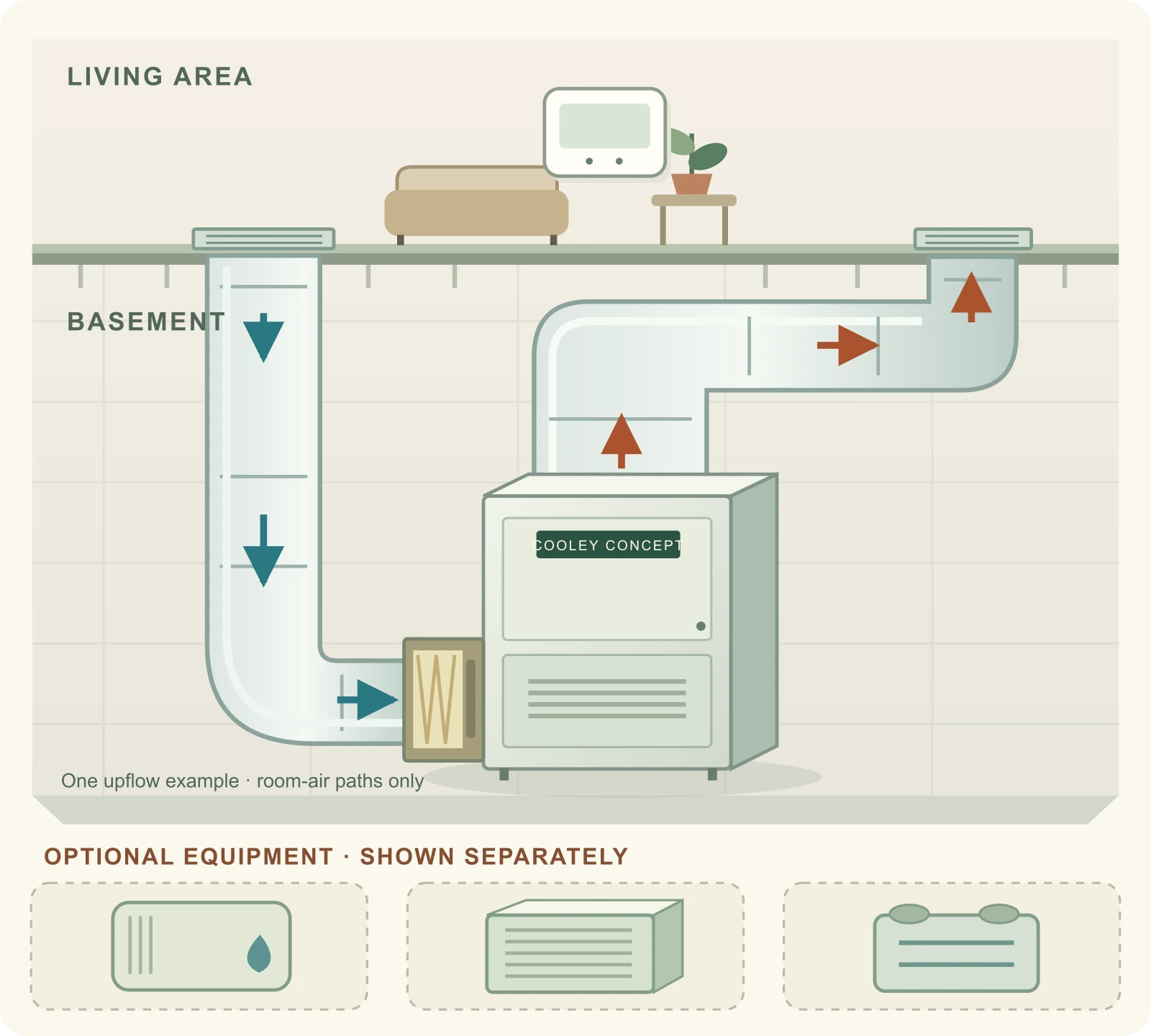
Arrows describe room-air circulation, not combustion air or exhaust. Equipment connections and suitability need a qualified assessment.
The eight parts and their guides
- Furnace
Heats the air; the blower moves air through the ducts.
Explore furnace types - Return air
Carries room air back toward the equipment.
Understand airflow and heating - Supply air
Carries conditioned air toward the rooms.
See how the system moves air - Filter
Captures particles; fit and airflow requirements depend on the equipment.
Read filter-fit questions - Thermostat
The thermostat is shown on an interior wall away from the supply outlet. Actual placement and control compatibility follow the equipment requirements.
Explore compatible controls - Humidifier (optional)
Adds moisture when appropriate.
Compare humidifier types - Dehumidifier (optional)
Removes moisture when needed.
Compare indoor-air functions - Ventilation equipment (optional)
Provides intentional air exchange with outdoors.
Explore ventilation and indoor air
ENERGY STAR recommends a professional heating check in the fall. Ask what maintenance and measurements are appropriate for your equipment, what was found and what work is actually recommended. A symptom list is a starting point, not proof that a component needs replacement.
Follow the manufacturer’s test and replacement instructions for smoke and carbon monoxide alarms. CPSC recommends CO alarms on every level and outside sleeping areas. A test button is not a professional combustion inspection.
For more detail, read Furnace Warning Signs and What to Do. If the heat repeatedly shuts down or a new noise needs diagnosis, use the existing Washington Township furnace-repair page and describe the observations and repair history. Plumbing, drainage, electrical and elevated gutter work should go to the appropriate qualified trade.
Keep this list
Your fall walk-through
Check an item when the safe task is done—or when you have arranged the right help. Follow the fuller instructions above; this list is a reminder.